
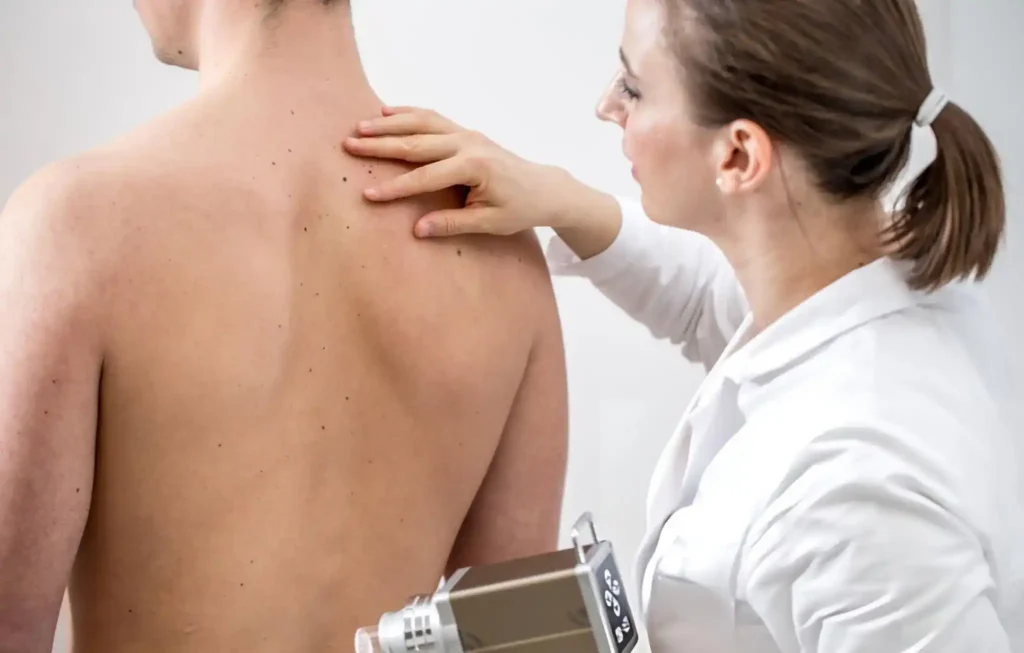
A spot, growth or rough patch on your skin can raise questions, especially if it has changed recently or will not go away on its own. Medical cryotherapy is a procedure that uses controlled extreme cold, commonly liquid nitrogen, to freeze selected surface skin lesions. The treated tissue is damaged by freezing and gradually clears as the skin heals.
Not every lesion is suitable for cryotherapy. A GP should assess the area first, because some spots may need a biopsy, removal or specialist referral instead.
Key Takeaways
- Cryotherapy uses liquid nitrogen to freeze selected surface skin lesions
- It may be used for viral warts, actinic keratoses and certain other benign lesions
- A GP should assess the lesion before treatment to confirm it is appropriate
- Redness, blistering and scabbing are common during healing
- Contact a GP if pain, redness or discharge increases after treatment
If you have noticed a new or changing skin lesion, skin cancer checks and lesion assessment at Huntlee Healthcare can help determine whether cryotherapy, monitoring or another approach may be appropriate.
How Does Cryotherapy Work on a Skin Lesion?
Liquid nitrogen is applied directly to the lesion, rapidly cooling the tissue to well below freezing. The freeze-and-thaw cycle damages the treated cells, and the body gradually clears the affected tissue over the following days and weeks.
The application method, freeze time and amount of surrounding tissue treated depend on the lesion’s type, size, depth and location. Some lesions require more than one freeze-thaw cycle in the same session. Liquid nitrogen may be delivered by spray, probe or cotton-tipped applicator.
Why Should a Skin Lesion Be Checked Before Cryotherapy?
This is the most important step. Cryotherapy destroys the treated tissue, so it may not be appropriate when a tissue sample is needed to confirm a diagnosis.
A GP assessment can help determine whether the lesion needs:
- monitoring over time
- cryotherapy
- biopsy or excision for pathology testing
- referral to a dermatologist or surgeon
Freezing an undiagnosed or suspicious lesion without assessment could delay the diagnosis of a condition that requires a different approach. A clinical examination and, in some cases, dermoscopy help a GP decide the most appropriate next step.
Which Skin Lesions May Be Treated With Cryotherapy?
Cryotherapy is generally used for surface-level lesions where the diagnosis is already clear. Common examples include:
- Viral warts
- Actinic keratoses (sun-damaged rough patches, sometimes called solar keratoses)
- Selected seborrhoeic keratoses
- Skin tags in certain locations
- Molluscum contagiosum in appropriate cases
Not every mole, pigmented spot or suspected skin cancer should be frozen. Pigmented or changing lesions may need biopsy or excision so a pathologist can examine the tissue. Your GP will discuss the most suitable option after examining the area.
What Happens During a Cryotherapy Procedure?
A typical cryotherapy appointment follows a straightforward sequence.
- The GP examines the lesion and confirms the treatment plan.
- The risks, alternatives and expected healing are discussed.
- Surrounding skin may be protected where needed.
- Liquid nitrogen is applied to the lesion using a spray, probe or applicator.
- The area freezes and then thaws.
- A second freeze may be applied depending on the lesion type and thickness.
- Aftercare and follow-up instructions are provided.
Most patients feel intense cold, stinging or a burning sensation during treatment. Tenderness around the area may continue for a short time afterwards.
What Should You Expect During Healing?
Healing after cryotherapy varies depending on the treatment site, how deeply the area was frozen and the type of lesion. Facial sites often heal sooner, while hands and lower legs may take noticeably longer.
| Expected changes | Changes needing GP review |
| Mild stinging or tenderness | Increasing or severe pain |
| Redness and swelling | Spreading redness |
| Clear or blood-filled blister | Thick yellow fluid or pus |
| Scab or crust forming | Ongoing or unusual bleeding |
| Temporary colour change | Delayed or unusual healing |
A clear or blood-filled blister may form within several hours and is commonly part of the healing response. Do not deliberately puncture it unless advised by a healthcare professional.If the area becomes increasingly painful, swollen or develops discharge, contact your GP for review.
How Do You Care for the Area After Cryotherapy?
Your GP will provide specific aftercare instructions. General guidance includes:
- Gently wash the area and keep it clean
- Use a dressing if clothing or footwear rubs against the site
- Avoid picking or removing any scab that forms
- Ask your GP before applying antiseptics, creams or other products
- Protect healing skin from direct sun exposure
- Return for review if symptoms worsen or the area does not heal as expected
DermNet provides further cryotherapy aftercare guidance, including expected blistering, wound care and signs of infection.
What Are the Possible Risks and Side Effects?
Like any procedure, cryotherapy carries some risks. These may include:
- Pain or tenderness during and after treatment
- Blistering, bleeding or ulceration
- Infection at the treatment site
- Temporary or permanent skin colour change (lighter or darker than surrounding skin)
- Scarring
- Temporary nerve symptoms such as numbness or tingling
- Hair loss in treated hair-bearing areas
- The lesion persisting or returning after treatment
Pigmentation changes may be more noticeable in people with darker skin tones. Your GP should discuss relevant risks with you before treatment so you can make an informed decision.
How Much Does Skin Cryotherapy Cost?
The cost can depend on the consultation type, the lesion, the procedure itself and whether further investigation is needed. Huntlee Healthcare states that in-clinic procedures may attract a private or gap fee beyond the standard consultation. Check the clinic’s current consultation and procedure fees or contact reception before booking to confirm costs and any applicable Medicare rebate.
Should You Ask a GP About Cryotherapy?
Cryotherapy can be a practical option for selected surface skin lesions, but it is not the right approach for every spot or growth. Clinical assessment should always come first. Healing and treatment response vary between patients, and more than one session may sometimes be needed.
If you have a skin lesion you would like assessed, patients in Huntlee and North Rothbury can book a skin assessment with a GP at Huntlee Healthcare to discuss whether cryotherapy or another approach may be suitable.
FAQ
Does cryotherapy for skin lesions hurt?
It may cause stinging, burning or discomfort during the freezing, followed by tenderness. The experience varies depending on the lesion type, treatment site and depth of freezing. Discomfort is often brief, but the experience varies with the lesion, treatment site and depth of freezing.
Is blistering normal after cryotherapy?
A clear or blood-filled blister can form within hours of treatment and is a common part of healing. Contact your GP if pain, redness or discharge increases rather than settles.
How long does cryotherapy take to heal?
Healing time varies by body site, lesion depth and how intensively the area was treated. Healing varies by site and treatment depth. A facial scab may come away within about one to two weeks, while hands may take around three weeks. Lower-leg sites can take much longer to heal.
Can cryotherapy leave a scar?
Scarring and permanent colour change are possible, although they do not occur in every patient. Your GP should discuss the likelihood of cosmetic changes before proceeding with treatment.
Can I use a home-freezing kit instead of seeing a GP?
Over-the-counter wart-freezing products are not equivalent to clinical liquid nitrogen. They may have a limited role for some common warts, but they should not be used on undiagnosed, pigmented or suspicious lesions. A GP assessment is the appropriate first step.
This article is intended for general health education purposes only. It does not constitute medical advice and should not replace consultation with a qualified healthcare professional. If you have concerns about a skin lesion or any aspect of your health, please speak with your GP.
Sources and Further Reading
- RACGP — Optimising Cryosurgery Technique
- DermNet — Cryotherapy: Uses, Cautions and Aftercare
- British Association of Dermatologists — Cryotherapy Patient Information
- University Hospitals Sussex NHS Foundation Trust — Cryotherapy